

The Trust Problem Most Leaders Never Name
- Heath Haynes
- Mar 17
- 5 min read

Most leadership and performance problems are not communication problems, accountability problems, or execution problems. They are trust deficits in disguise.
If your team is disengaged, your communication is strained, or the same friction keeps resurfacing despite your best interventions, there is a good chance the root issue is trust… and a better chance you have not named it precisely enough to fix it.
That is the problem. Most leaders know trust matters. Few know how to diagnose where it is actually breaking down.
Why Leaders Miss the Real Problem
When performance slips, leaders tend to reach for familiar levers: a new process, a sharper accountability system, another all-hands meeting. These are not wrong moves. But they often treat symptoms while the underlying condition goes unaddressed.
The reason is straightforward. Trust is difficult to discuss at the executive level without it sounding like a team-building conversation. So leaders avoid naming it. They reframe the problem as a strategic misalignment, a communication gap, or a talent issue; when what they are really dealing with is a team where the relational foundation has eroded.
You cannot build a high-performing culture on a cracked foundation. Understanding how trust breaks down is the first step to rebuilding it.
The Four Components of Trust
The Influence Model framework identifies four distinct components that people evaluate, consciously or not, when deciding whether to extend trust to a leader or colleague.
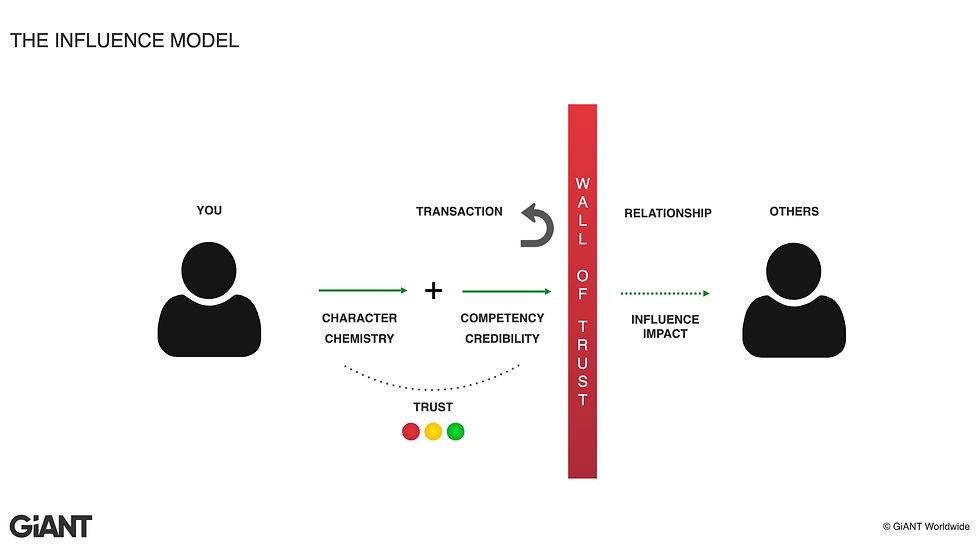
They are:
Character — Do I trust you? Are you a person of integrity? Are you for me, or for yourself?
Chemistry — Do I like you? Do I connect with you? Do I enjoy working alongside you?
Competency — Do you know what you are doing? Do you have a proven track record? Can you speak with confidence about your domain?
Credibility — Is your competence relevant to my actual situation? Can you take what you know and apply it to the complexity of my reality?
Every interaction you have with a team member is sending a signal in one or more of these four areas and will determine whether or not their "Wall of Trust" comes down. The signal is either green (trust building), yellow (trust stalled), or red (trust eroding). When you miss the mark consistently, even unintentionally, trust stalls out, and performance follows.
The leadership mistake is treating all four as interchangeable. They are not. A breakdown in each one looks different, sounds different, and requires a different response.
What Each Breakdown Looks Like in Practice
When Character Is in Question
This is the hardest breakdown to address because it is the most personal. A character deficit is not always about dishonesty. More often, it shows up as a persistent perception that the leader is primarily self-interested.
Watch for: team members who stop sharing real information, who hedge their commitments, or who have quiet conversations outside of formal meetings. When people do not believe a leader is genuinely for them, they manage up rather than perform. They protect themselves rather than invest.
If your people are careful around you, that is a character signal worth taking seriously.
When Chemistry Is Missing
Chemistry is not about being likable in a social sense. It is about connection; the sense that a leader sees people as people, not just as functions. When chemistry is absent, teams become transactional. People show up, deliver their output, and disengage.
Watch for: minimal voluntary communication, low energy in meetings, cross-functional collaboration that feels forced rather than natural. People do not go the extra distance for leaders they feel no connection with (no matter how capable those leaders are).
When Competency Is in Doubt
Competency deficits are the most visible, but leaders frequently underestimate how quickly perception of incompetence spreads. One poorly framed decision, one gap in domain knowledge exposed publicly, one forecast that misses badly and a team begins quietly questioning whether their leader knows what they are doing.
Watch for: pushback that sounds like clarifying questions but is really testing your reasoning, slow adoption of your direction, or a pattern where people route around you to get things done. These are not defiance signals, they are competency-doubt signals.
When Credibility Is Absent
Credibility is where competency meets relevance. You may be highly capable in your domain, but if your team believes your knowledge does not apply to their specific challenges, they will not follow your lead with confidence.
This is especially common in scaling organizations, where a leader's experience base is outpaced by the complexity of a new season. It also surfaces when leaders bring in external frameworks without earning the trust that makes those frameworks land.
Watch for: polite compliance without genuine buy-in, people going through the motions of your initiatives, and persistent skepticism about whether the strategy will actually work in your context.
How to Use This as a Diagnostic, Not a Judgment
The value of this framework is diagnostic precision. Before your next difficult conversation, or before you redesign a process, add a layer of accountability, or restructure a team, ask the following questions:
Is there a Character issue? Does this person (or does my team) believe I am genuinely for them—not just for results?
Is there a Chemistry issue? Is there relational mutuality, or has this become purely transactional?
Is there a Competency issue? Does my team believe I know what I am doing? Do I?
Is there a Credibility issue? Does my team believe what I know actually applies to what we are facing right now?
The answer may be one, it may be several. But naming the right component is what allows you to address it with precision rather than guessing.
The Leader's Responsibility
Here is the part that requires honesty: in most cases, the trust deficit starts with the leader, not the team.
This is not an indictment. It is an opportunity. If you are the common denominator in recurring friction, disengagement, or breakdown, you also have the most leverage to change it. That is not a burden. That is a significant leadership advantage… if you are willing to look clearly at it.
The question is not whether your people should trust you. The question is whether you have done the intentional work of building trust in the specific ways your team needs to receive it.
Trust is not a byproduct of good intentions. It is built through consistent, targeted action across all four components: Character, Chemistry, Competency, and Credibility.
When you build it well, you stop managing friction. You start leading people who are genuinely invested in the mission. That is when performance becomes sustainable.
Ready to Diagnose the Real Problem?
If your team is experiencing friction, disengagement, or inconsistent execution, the root issue may be a trust deficit that has never been named clearly.
At L3 Leadership Coaching, we help senior leaders and executive teams identify exactly where trust is breaking down so we can work with them to build the leadership habits that restore it at depth.
Book a free Discovery Call to start with a clear-eyed diagnosis of what is driving your team's performance challenges. You can also visit L3leadershipcoaching.com to learn more about us.
L3 Leadership Coaching | Liberating Leaders That Last


